

Hospital Robotics Logistics and Pharmacy Market to Reach US$ 14.77 Billion by 2033 at 13.3% CAGR
Hospital Robotics Logistics and Pharmacy Market
Hospital Robotics Logistics and Pharmacy Market to Reach US$ 14.77 Billion by 2033 at 13.3% CAGR; North America Leads with 36% Share
The hospital robotics (logistics and pharmacy) market is growing steadily, driven by healthcare automation and the need for greater operational efficiency.”
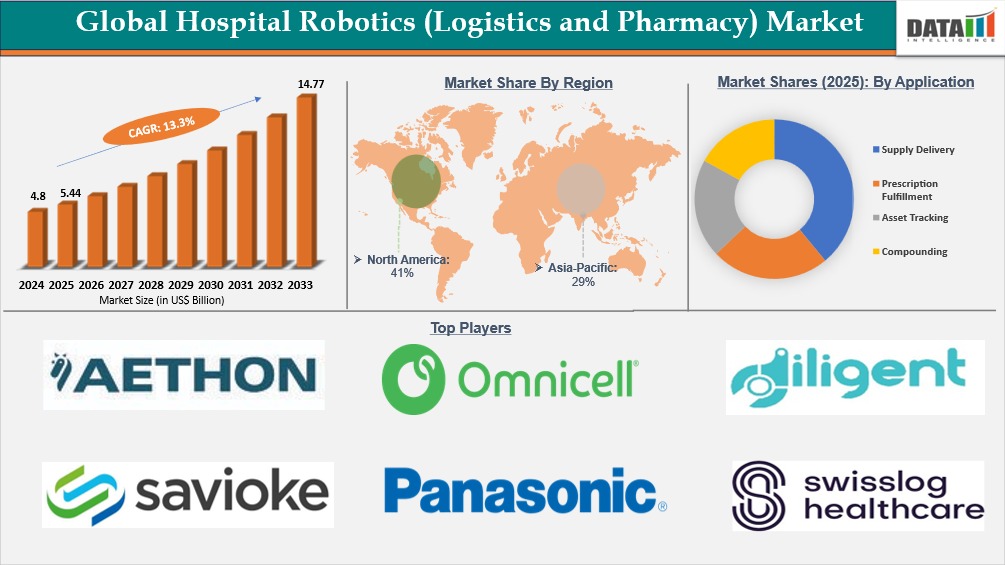
LEANDER, TX, UNITED STATES, February 27, 2026 /EINPresswire.com/ -- According to DataM Intelligence, the Hospital Robotics (Logistics and Pharmacy) Market reached US$ 4.8 billion in 2024, rising to US$ 5.44 billion in 2025 and is projected to reach US$ 14.77 billion by 2033, growing at a CAGR of 13.3 percent during the forecast period 2026 to 2033. Market growth is driven by increasing hospital workloads, rising complexity of medication management, and persistent shortages of healthcare professionals. With the expanding population aged over 65 and the growing prevalence of chronic diseases, hospital admissions and outpatient visits continue to increase, placing significant operational pressure on pharmacy and logistics departments.— DataM Intelligence
Medication safety remains a key driver for automation. According to the World Health Organization, medication errors account for approximately US$ 42 billion in global healthcare costs annually, nearly 1 percent of total healthcare expenditure. A large proportion of these errors occur during dispensing and administration, encouraging hospitals to deploy Automated Dispensing Machines and robotic compounding systems. Studies show that automation can reduce medication distribution errors by 30 to 50 percent, improving compliance and patient safety. On the logistics side, autonomous mobile robots are increasingly used to transport medications, laboratory samples, and medical supplies, reducing manual workload by up to 60 to 70 percent in certain settings. With projections indicating that one in six people worldwide will be over 65 by 2050 and an estimated global shortage of 10 million healthcare workers by 2030, automation in hospital environments is expected to remain a critical long term growth driver.
Download your exclusive sample report today: (corporate email gets priority access): https://www.datamintelligence.com/download-sample/hospital-robotics-logistics-and-pharmacy-market
Key Developments
February 2026: In North America, Stryker expanded deployment of autonomous hospital logistics robots integrated with real-time location systems (RTLS) and AI-based task scheduling software across major hospital networks, improving internal supply chain efficiency and reducing caregiver workload.
January 2026: In Europe and the Middle East, Swisslog Healthcare launched enhanced robotic pharmacy dispensing systems featuring automated unit-dose packaging and cloud-connected inventory management tools to support large scale hospital pharmacies and outpatient dispensaries.
December 2025: In Asia Pacific, Aethon expanded its TUG autonomous mobile robot platform within major hospitals in Japan and South Korea, integrating advanced navigation and safety systems to streamline delivery of medications, linens, and supplies.
November 2025: In the United States, Omnicell introduced next-generation robotic pharmacy automation solutions with integrated barcode verification, secure controlled substance tracking, and enhanced workflow analytics for enterprise hospital pharmacies.
October 2025: In Latin America, Panasonic Healthcare deployed autonomous delivery robots in hospital logistics departments to support internal distribution of meals, supplies, and specimens with improved operational reliability and remote monitoring capabilities.
September 2025: In global markets, Fetch Robotics expanded its healthcare robotics portfolio to include specialized robots for pharmacy transport and inventory tasks, and outlined plans for broader integration with electronic health record (EHR) systems to enhance tracking and task coordination.
Key Segments
By Type of Robot
Autonomous mobile robots are widely used for transporting medicines, laboratory samples, and medical supplies across hospital departments. Automated guided vehicles operate along predefined routes to support internal logistics and material handling. Robotic pharmacy dispensing systems are designed to automate medication storage, sorting, and dispensing with high accuracy. Collaborative robots are increasingly deployed to work alongside hospital staff in pharmacy and inventory management tasks.
By Functionality
Medication dispensing and verification represent a core function, reducing human error and enhancing patient safety. Inventory management robots track stock levels, expiry dates, and replenishment cycles in real time. Material transport robots streamline internal logistics by delivering drugs, surgical tools, and consumables. Sterilization and disinfection robots support infection control protocols in pharmacy and storage areas.
By Technology
Artificial intelligence and machine learning enable route optimization, demand forecasting, and intelligent medication management. Computer vision systems enhance navigation and barcode verification processes. Radio frequency identification technology supports real time inventory tracking and asset monitoring. Cloud based analytics platforms facilitate centralized monitoring and data driven decision making.
By End User
Large hospitals account for the majority share due to high patient volumes and complex logistics requirements. Medium sized hospitals are increasingly adopting robotic systems to improve operational efficiency. Specialty hospitals and clinics deploy pharmacy automation solutions to enhance accuracy and reduce medication errors. Other end users include academic medical centers and research hospitals.
By Application
Logistics applications focus on automated transportation of pharmaceuticals, laboratory samples, and medical supplies within hospital premises. Pharmacy automation applications include medication compounding, packaging, labeling, and dispensing. Waste management and reverse logistics functions are also supported by robotic systems in hospital environments.
By Deployment Model
On premises deployment remains common due to data security and integration requirements with existing hospital information systems. Cloud based deployment is gaining traction for centralized monitoring, software updates, and scalable analytics capabilities across multi hospital networks. Hybrid deployment models combine on premises robotic infrastructure with cloud based management platforms for optimized performance and compliance.
Buy Now & Unlock 360° Market Intelligence: https://www.datamintelligence.com/buy-now-page?report=hospital-robotics-logistics-and-pharmacy-market
Key Players
Aethon Inc. | Omnicell, Inc. | Diligent Robotics, Inc. | Panasonic Corporation | Savioke, Inc. | Mobile Industrial Robots A/S | Stryker Corporation | Siemens Healthineers AGgerman medical technology company"] | Swisslog Healthcare | UBTech Robotics Corp. | Others
Regional Insights
North America – 36% share: “Driven by high healthcare spending, early adoption of automation, and strong presence of robotics solution providers in the United States and Canada.”
Europe – 28% share: “Supported by established healthcare systems, focus on operational efficiency, and growing deployments of logistics and pharmacy automation.”
Asia Pacific – 27% share: “Fueled by hospital modernization, increasing healthcare investments, and rising demand for robotics in China, India, Japan, and Southeast Asia.”
Latin America – 5% share: “Boosted by gradual adoption of hospital robotics, expanding healthcare infrastructure, and efforts to improve logistics efficiency.”
Middle East & Africa – 4% share: “Driven by healthcare development initiatives, investments in automation, and early-stage robotics implementations.”
Get Customization in the report as per your requirements: https://www.datamintelligence.com/customize/hospital-robotics-logistics-and-pharmacy-market
Frequently Asked Questions (FAQs):
How big is the global hospital robotics (logistics and pharmacy) market in terms of growth forecast?
The global hospital robotics (logistics and pharmacy) market was valued at around US$ 5.44 billion in 2025 and is projected to reach approximately US$ 14.77 billion by 2033, reflecting significant growth over the forecast period.
What is the projected CAGR for the hospital robotics (logistics and pharmacy) market?
The market is expected to grow at a compound annual growth rate of about 13.3% during the forecast period from 2026 to 2033.
Which region currently dominates the hospital robotics (logistics and pharmacy) market?
North America dominates the market due to advanced healthcare infrastructure, strong adoption of automation technologies, and increased investments in robotic systems for hospital operations.
Which region is growing the fastest in this market?
The Asia-Pacific region is projected to witness the fastest growth, driven by rising healthcare modernization initiatives, expanding hospital infrastructure, and increasing adoption of robotic technologies.
What are the key growth drivers for hospital robotics in logistics and pharmacy?
Key growth drivers include healthcare workforce shortages, the need to reduce medication errors, increasing patient admissions, expansion of centralized pharmacy operations, and growing adoption of autonomous mobile robots for internal hospital logistics.
Which application segment leads the market?
The supply delivery and logistics segment leads the market, with autonomous mobile robots widely used for transporting medications, lab samples, medical supplies, and other essential materials within hospitals.
Conclusion:
The global hospital robotics (logistics and pharmacy) market is set for strong expansion as hospitals increasingly adopt autonomous mobile robots and pharmacy automation to improve internal supply delivery, enhance medication safety, and reduce workload on clinical staff. This growth is fueled by rising healthcare demands, workforce shortages, and the need for more efficient and error-free processes in logistics and pharmacy departments, with the market projected to grow significantly through 2033. While challenges such as integration with legacy hospital systems remain, continued innovation and smart hospital initiatives are driving broader implementation. Overall, robotics solutions in hospital logistics and pharmacy are becoming essential for optimizing operations, boosting patient care efficiency, and addressing critical labor and safety pressures in healthcare systems.
Related Reports:
1. Artificial Intelligence (AI) Robots Market
2. Japan Surgical Robot Systems Market
Sai Kiran
DataM Intelligence 4market Research LLP
+1 877-441-4866
email us here
Visit us on social media:
LinkedIn
YouTube
X
Legal Disclaimer:
EIN Presswire provides this news content "as is" without warranty of any kind. We do not accept any responsibility or liability for the accuracy, content, images, videos, licenses, completeness, legality, or reliability of the information contained in this article. If you have any complaints or copyright issues related to this article, kindly contact the author above.
