

Global Battery Thermal Pump Couplings Market to Surge to USD 0.9 Billion by 2036 as Electric Vehicle Thermal Management
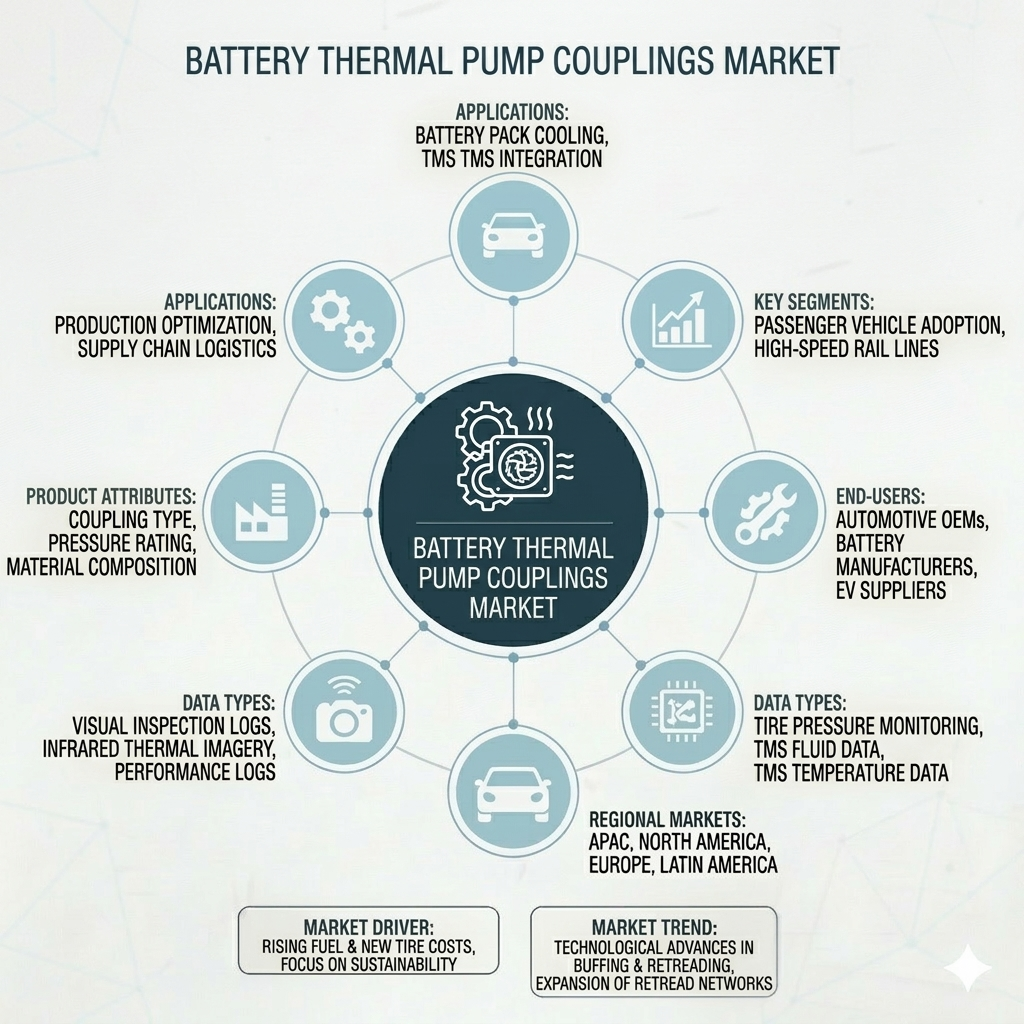
Battery Thermal Pump Couplings Market Outlook
Global battery thermal pump couplings market is forecasted to reach USD 0.3 billion in 2026 and expand to USD 0.9 billion by 2036, advancing at a CAGR of 11.6%.
NEWARK, DE, UNITED STATES, March 19, 2026 /EINPresswire.com/ -- The global automotive industry’s pivot toward high-efficiency electric mobility is fundamentally re-engineering the sub-component landscape. According to a definitive strategic study released today, the Battery Thermal Pump Couplings Market is forecasted to grow from USD 0.3 billion in 2026 to USD 0.9 billion by 2036, advancing at a robust compound annual growth rate (CAGR) of 11.6%.
This growth represents a critical shift in EV architecture. As battery densities increase and charging speeds accelerate, traditional mechanical cooling connections are proving insufficient. The industry is rapidly transitioning toward precision-engineered magnetic and elastomeric coupling platforms that ensure maintenance-free, airtight thermal regulation—a non-negotiable requirement for the next generation of long-range electric vehicles.
The Efficiency Revolution: From Mechanical Drives to Magnetic Innovation
The value proposition of thermal pump couplings has evolved from simple power transmission to a sophisticated role in battery protection. By leveraging Advanced Magnetic Coupling Engineering, manufacturers are now delivering systems that offer controlled heat transfer without the risk of fluid leakage or mechanical wear.
Get Access of Report Sample:
https://www.futuremarketinsights.com/reports/sample/rep-gb-32069
Key Technology Insights for 2026:
• Elastomeric Dominance (38.0% Share): Elastomeric flexible couplings remain the leading solution due to their exceptional vibration absorption and versatility. These systems are vital for protecting sensitive battery cells from the harmonic vibrations generated by high-speed electric coolant pumps.
• Magnetic Growth (22.0% Share): Magnetic couplings are the fastest-growing sub-segment. By eliminating physical contact between the motor and the pump impeller, these systems provide a hermetically sealed environment, effectively removing the primary failure point in EV thermal loops—the shaft seal.
• Passenger EV Focus (66.0% Share): The passenger vehicle segment remains the primary volume driver. As consumers demand "winter-proof" EVs, manufacturers are integrating advanced couplings into complex heat pump modules to maintain battery performance in sub-zero temperatures.
MAHLE’s Strategic Leap: The "HeatX Range+" Breakthrough
In a landmark industry development in February 2026, MAHLE GmbH unveiled its innovative HeatX Range+ heat recovery system. This technology utilizes precision thermal pump orchestration to maximize cabin heating efficiency without draining the battery’s core energy reserves.
"Our HeatX Range+ concept maximizes the everyday practicality of electric vehicles in winter and makes a decisive contribution to further increasing the attractiveness of electric mobility," explained Martin Wellhoeffer, Member of the MAHLE Group Management Board. This advancement underscores the industry's shift toward integrated thermal modules that rely on high-performance couplings for seamless operation.
Regional Outlook: China Scales at 14.0% CAGR
Global market dynamics are being shaped by national EV adoption rates and the expansion of manufacturing infrastructure.
The global battery thermal pump couplings market is exhibiting a rapid growth trajectory, primarily fueled by national electric vehicle (EV) mandates and the pursuit of precision thermal management. China is projected to lead the expansion with a 14.0% CAGR, driven by a massive surge in domestic EV brands and a strategic push for high-quality thermal standardization across its manufacturing base. The United States follows with an 11.0% CAGR, supported by the burgeoning commercial EV sector and federal incentives designed to bolster domestic battery production and infrastructure. In Germany, the market is expected to grow at a 10.8% CAGR, anchored by the country's historic engineering excellence in premium EV thermal systems and the global leadership of its Tier-1 automotive suppliers.
Innovation and regulatory compliance also define the growth in other key regions. The United Kingdom is set to experience a 10.7% CAGR, as a result of its strong focus on clean-tech innovation and stringent regulatory frameworks regarding EV battery safety. Meanwhile, Japan is forecasted to advance at a 9.9% CAGR, where market growth is underpinned by the country’s specialized precision manufacturing capabilities and a unique convergence of advanced, high-tech thermal formulations designed to maximize battery longevity.
China is set to remain the growth epicenter. In November 2025, MAHLE reinforced this position by inking a strategic deal with Shanghai Jiapèi, leveraging a 45-workshop network to expand aftermarket thermal servicing—a move that highlights the growing importance of replacement-grade couplings as the global EV fleet ages.
Competitive Landscape: The Rise of Comprehensive Thermal Solutions
The competitive arena is consolidating as Tier-1 suppliers move from component manufacturing to becoming "system architects." Major players are aggressively acquiring specialized expertise to offer end-to-end thermal management:
• Valeo SA signaled its dominance in July 2022 by acquiring Siemens’ 50% stake in Valeo Siemens eAutomotive, integrating high-voltage power electronics directly with its thermal coupling portfolios.
• Denso Corporation and Bosch Group are leading the integration of "smart" sensors into elastomeric couplings to monitor real-time thermal variability and vibration data.
Leading Players in the Battery Thermal Pump Couplings Market:
• MAHLE GmbH
• Denso Corporation
• Valeo SA
• Bosch Group (Robert Bosch GmbH)
• Schaeffler Technologies AG & Co. KG
• BorgWarner Inc.
• KTR Systems GmbH
• Aisin Corporation
• Nidec Corporation
• Continental AG
Executive Summary & Strategic Takeaways
For automotive OEMs and thermal system designers, the message is clear: the coupling is no longer a "commodity" part.
1. Prioritize Maintenance-Free Designs: Magnetic couplings offer a significant TCO (Total Cost of Ownership) advantage by eliminating leak-prone seals.
2. Focus on Vibration Isolation: As EV motors reach higher RPMs, the selection of elastomeric materials becomes critical to prevent resonance-related battery housing fatigue.
3. Mandate Thermal Standardization: Regulatory momentum is shifting toward standardized cooling loops. Sourcing couplings that meet international EV safety benchmarks is essential for global market access.
Frequently Asked Questions (FAQ)
1. Why is a coupling so important for a battery's thermal pump?
In an EV, the thermal pump must move coolant or refrigerant with absolute precision. The coupling connects the electric motor to the pump. If the coupling fails or vibrates excessively, the pump fails, the battery overheats, and the vehicle enters "limp mode" or faces permanent cell damage.
2. What are the benefits of Magnetic Couplings over traditional mechanical ones?
Magnetic couplings use magnetic fields to transmit torque through a solid barrier. This means there are no seals to leak, no friction to create heat, and no mechanical parts to wear out. They are essentially "fit and forget" components for the life of the vehicle.
3. How does the "Winter Range" of an EV relate to these couplings?
Advanced systems like MAHLE's HeatX rely on the thermal pump's ability to recover waste heat from the battery and drivetrain. Precise couplings ensure these pumps run at peak efficiency, allowing the car to heat the cabin without significantly reducing the driving range.
4. Is this market only for passenger cars?
While passenger EVs hold a 66% share, there is a massive emerging market in Industrial Battery Energy Storage Systems (BESS). These massive battery "farms" require high-capacity thermal pumps and heavy-duty metal disc or elastomeric couplings to maintain stable temperatures during peak grid discharge.
Brows More Industry Reports :
Battery Thermal Plates Market
https://www.futuremarketinsights.com/reports/battery-thermal-plates-market
EV Battery Pack Thermal Interface Materials (TIM) Market
https://www.futuremarketinsights.com/reports/ev-battery-pack-thermal-interface-materials-tim-market
Lithium Battery Thermal Runaway Sensor Modules Market
https://www.futuremarketinsights.com/reports/lithium-battery-thermal-runaway-sensor-modules-market
Sudip Saha
Future Market Insights Inc.
+1 347-918-3531
email us here
Legal Disclaimer:
EIN Presswire provides this news content "as is" without warranty of any kind. We do not accept any responsibility or liability for the accuracy, content, images, videos, licenses, completeness, legality, or reliability of the information contained in this article. If you have any complaints or copyright issues related to this article, kindly contact the author above.
