

Global Green & Bio-based Polyol Market to Reach USD 39.21B by 2036, Led by Covestro, BASF & Dow
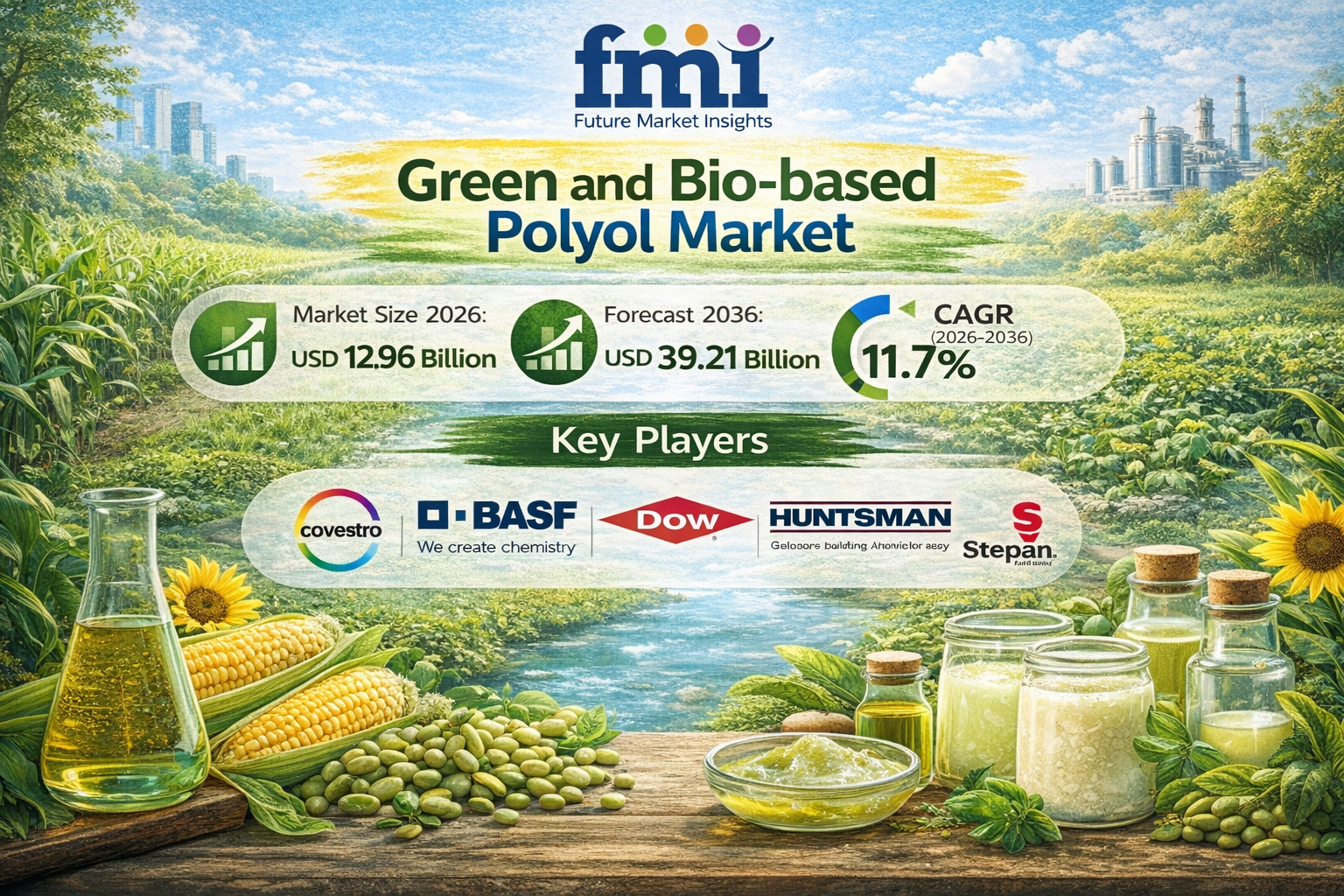
Renewable feedstocks reshape polyurethane production strategies worldwide. Bio-based polyols gain traction across construction, furniture, and auto sectors.
NEWARK, DE, UNITED STATES, March 26, 2026 /EINPresswire.com/ -- The global green and bio-based polyol market is entering a high-growth phase, driven by increasing sustainability mandates and the shift toward low-carbon materials. Valued at USD 12.96 billion in 2026, the market is projected to reach USD 39.21 billion by 2036, expanding at a CAGR of 11.7%. This growth reflects a structural transformation in polyurethane value chains, with renewable and recycled feedstocks gradually replacing conventional petrochemical-based polyols.
Rising regulatory pressure, green building certifications, and corporate decarbonization goals are accelerating adoption across industries such as construction, automotive, and furniture. Bio-based polyols are gaining traction as they offer comparable performance while significantly reducing carbon footprints.
Market Dynamics
Key Growth Drivers
Demand is primarily fueled by the construction sector, where polyurethane insulation materials are increasingly specified to meet energy efficiency and carbon reporting standards. Automotive manufacturers are also incorporating bio-based foam solutions in seating and interiors to align with sustainability targets. Additionally, consumer-facing industries such as furniture and bedding are adopting bio-content materials to strengthen ESG positioning.
Technology and Innovation
Digital tools are reshaping the market landscape. Platforms like CQ-Configurator by Covestro enable real-time calculation of CO₂ footprint and sustainable content in polyurethane formulations, improving transparency and accelerating adoption of mass-balanced bio-polyols.
Sustainability Shift
The market is transitioning from cost-driven procurement to verification-driven purchasing, where traceability, certification (e.g., ISCC PLUS), and lifecycle emissions data are critical decision factors. This is especially evident in regulated markets and large-scale construction projects.
Request For Sample Report | Customize Report |purchase Full Report - https://www.futuremarketinsights.com/reports/sample/rep-gb-273
Segment Analysis
By Product Type
Bio-based polyols dominate the market with an estimated 55% share in 2026, driven by easier integration into existing polyurethane formulations and growing demand for traceable renewable content.
By Application
Foam insulation leads with approximately 34% market share, supported by strong demand in building envelopes, refrigeration, and thermal insulation systems.
By End Use
Construction remains the largest segment, accounting for around 44% of total demand, as sustainability regulations and energy efficiency standards increasingly influence material selection.
Regional Insights
Asia Pacific, particularly China, leads market expansion with a projected 13.4% CAGR, supported by large-scale industrial production and strong policy backing for low-carbon materials. India follows closely at 12.8% CAGR, driven by housing programs, infrastructure growth, and increasing polyurethane consumption.
Brazil benefits from abundant bio-based feedstock availability, while the United States shows steady growth supported by ESG-driven procurement and building retrofit initiatives. Europe remains a compliance-driven market where strict environmental regulations continue to shape demand.
Competitive Landscape
The market is moderately fragmented, with global chemical companies and regional producers competing on sustainability credentials, product performance, and supply reliability. Key players are focusing on:
• Mass-balance and bio-circular product portfolios
• Certification-backed supply chains
• Integration across polyurethane value chains
• Collaboration with OEMs for faster product qualification
Companies with strong traceability systems and performance-equivalent bio-based solutions are gaining a competitive edge.
Key Players: Covestro AG, BASF SE, Dow Inc., Huntsman Corporation, Stepan Company, Mitsui Chemicals, Inc., Tosoh Corporation, Manali Petrochemicals Limited
Frequently Asked Questions (FAQs)
1. What is the market size of green and bio-based polyols?
The market is valued at USD 12.96 billion in 2026 and is expected to reach USD 39.21 billion by 2036.
2. What is driving market growth?
Growth is driven by sustainability regulations, green building standards, and increasing demand for low-carbon materials in construction and automotive sectors.
3. Which segment dominates the market?
The construction sector leads, accounting for the largest share due to high demand for insulation and polyurethane materials.
4. What are bio-based polyols used for?
They are used in manufacturing polyurethane products such as foams, coatings, adhesives, sealants, and elastomers.
5. Which region is growing the fastest?
China and India are the fastest-growing markets due to rapid industrialization and strong demand for sustainable materials.
Explore More Related Studies Published by FMI Research:
Fluoropolymer Market: https://www.futuremarketinsights.com/reports/fluoropolymers-market
Industrial Gases Market: https://www.futuremarketinsights.com/reports/industrial-gases-market
Microwave Absorbing Material Market: https://www.futuremarketinsights.com/reports/microwave-absorbing-materials-market
About Future Market Insights (FMI)
Future Market Insights, Inc. (FMI) is an ESOMAR-certified, ISO 9001:2015 market research and consulting organization, trusted by Fortune 500 clients and global enterprises. With operations in the U.S., UK, India, and Dubai, FMI provides data-backed insights and strategic intelligence across 30+ industries and 1200 markets worldwide.
Why Choose FMI: https://www.futuremarketinsights.com/why-fmi
Sudip Saha
Future Market Insights Inc.
+1 347-918-3531
rahul.singh@futuremarketinsights.com
Legal Disclaimer:
EIN Presswire provides this news content "as is" without warranty of any kind. We do not accept any responsibility or liability for the accuracy, content, images, videos, licenses, completeness, legality, or reliability of the information contained in this article. If you have any complaints or copyright issues related to this article, kindly contact the author above.
