

Connected Living Room Market to Reach US$ 116.2 Billion by 2033, Growing at 8.5% CAGR
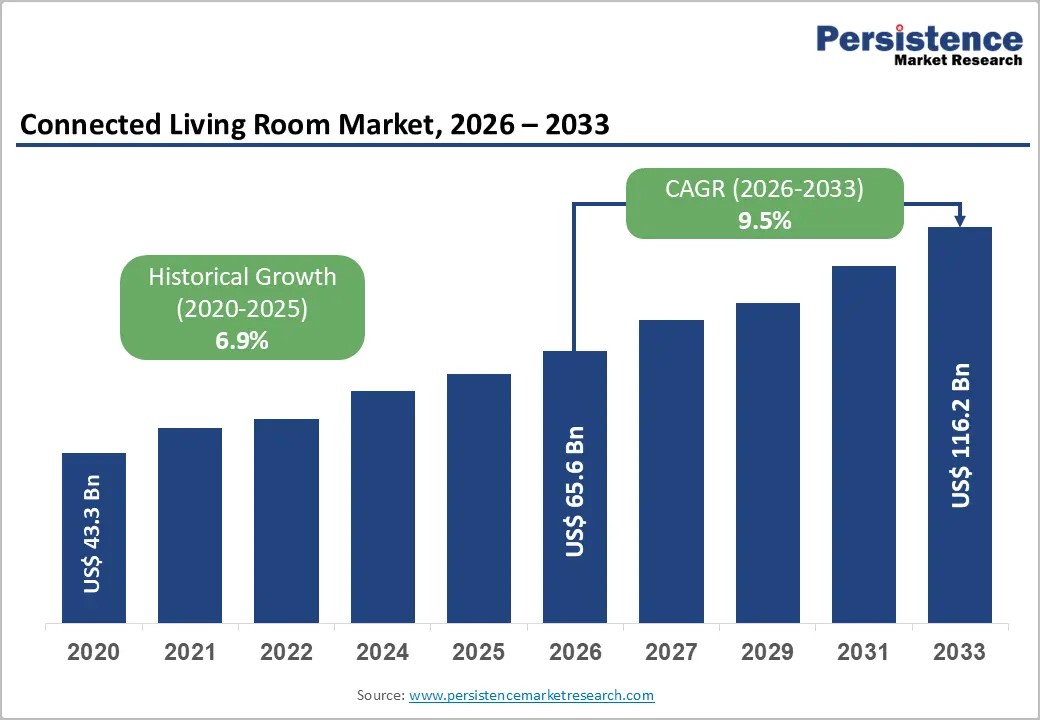
The global connected living room market is projected to reach US$ 116.2 Bn by 2033, growing at an 8.5% CAGR during 2026–2033, driven by smart home demand
BRENTFORD, ENGLAND, UNITED KINGDOM, July 21, 2026 /EINPresswire.com/ -- The global connected living room market is undergoing significant transformation as households increasingly adopt smart entertainment systems, connected devices, and integrated home automation solutions. The market size is expected to reach US$ 65.5 billion in 2026 and is projected to grow to US$ 116.2 billion by 2033, expanding at a CAGR of 8.5% between 2026 and 2033. This growth is supported by rising household digitalization, expanding broadband connectivity, increasing smart device adoption, and changing consumer preferences toward personalized and immersive home experiences.
The increasing penetration of internet-connected households is creating strong demand for connected living room ecosystems. According to the International Telecommunication Union (ITU), approximately 5.5 billion people, representing 68% of the global population, were active internet users in 2024. Advancements in Wi-Fi 6E technology, Matter 1.4 interoperability standards, artificial intelligence-powered voice assistants, OTT streaming platforms, and connected entertainment devices are enabling seamless integration between televisions, speakers, lighting systems, gaming devices, and smart home controls.
The Smart TVs and Streaming Devices segment dominates the product category, accounting for approximately 47% market share in 2025, driven by widespread adoption of connected televisions and streaming platforms. Home Entertainment and Media Streaming represents the leading application segment with nearly 56% share in 2025, supported by increasing consumption of Netflix, Disney+, Amazon Prime Video, and regional OTT platforms. Regionally, North America led the connected living room market in 2025, supported by mature broadband infrastructure, high consumer spending on premium electronics, and established ecosystems from Apple, Amazon, Google, and Roku. However, Asia Pacific is the fastest-growing region, expanding at a CAGR exceeding 9.5% through 2033, driven by rapid smart TV adoption, digital transformation, and increasing IoT penetration across China, India, and Southeast Asia.
𝐆𝐞𝐭 𝐚 𝐒𝐚𝐦𝐩𝐥𝐞 𝐏𝐃𝐅 𝐁𝐫𝐨𝐜𝐡𝐮𝐫𝐞 𝐨𝐟 𝐭𝐡𝐞 𝐑𝐞𝐩𝐨𝐫𝐭: https://www.persistencemarketresearch.com/samples/10840
Connected Living Room Market Segmentation Analysis
The connected living room market is segmented by product type, application, and end-user. Smart TVs and streaming devices dominate the product segment due to rising OTT adoption, AI-powered features, and integration with smart home ecosystems. Smart speakers and voice assistants are the fastest-growing category, supported by Matter interoperability and increasing demand for voice-controlled home experiences.
Home entertainment and media streaming lead the application segment as consumers shift toward OTT platforms, connected TVs, gaming systems, and immersive entertainment solutions. Cloud gaming, AR/VR devices, and advanced audio technologies are creating new growth opportunities. Individual households represent the largest end-user segment, driven by increasing smart device adoption, affordability, and demand for connected lifestyles, while hospitality and smart apartment projects are expanding B2B opportunities.
Regional Insights of the Connected Living Room Market
North America leads the connected living room market due to strong broadband infrastructure, high consumer spending, and established ecosystems from Apple, Amazon, Google, and Roku. The U.S. market benefits from widespread smart TV adoption, streaming growth, and demand for premium entertainment systems.
Europe holds a significant market share, supported by broadband penetration, privacy regulations, and growing adoption of Matter-enabled smart devices. Germany, the U.K., and France are key markets driven by premium electronics adoption and expanding streaming services.
Asia Pacific is the fastest-growing region, supported by digitalization, electronics manufacturing, and increasing smart device adoption. China leads regional growth with strong demand for smart TVs and IoT devices, while India, Japan, and South Korea are experiencing rapid expansion through OTT growth, broadband adoption, and smart home investments.
𝐃𝐨 𝐘𝐨𝐮 𝐇𝐚𝐯𝐞 𝐀𝐧𝐲 𝐐𝐮𝐞𝐫𝐲 𝐎𝐫 𝐒𝐩𝐞𝐜𝐢𝐟𝐢𝐜 𝐑𝐞𝐪𝐮𝐢𝐫𝐞𝐦𝐞𝐧𝐭? 𝐑𝐞𝐪𝐮𝐞𝐬𝐭 𝐂𝐮𝐬𝐭𝐨𝐦𝐢𝐳𝐚𝐭𝐢𝐨𝐧 𝐨𝐟 𝐑𝐞𝐩𝐨𝐫𝐭: https://www.persistencemarketresearch.com/request-customization/10840
Market Drivers Supporting Connected Living Room Market Growth
The connected living room market is driven by rising OTT streaming adoption, smart TV penetration, and increasing demand for digital entertainment experiences. The growth of Matter interoperability standards, AI-powered assistants, and voice-controlled devices is further improving connectivity and encouraging smart home adoption.
Market Restraints Affecting Connected Living Room Adoption
Cybersecurity risks, privacy concerns, fragmented device standards, and high costs of premium connected devices remain key challenges. Compatibility issues between different ecosystems and expensive smart entertainment setups may limit adoption among cost-sensitive consumers.
Market Opportunities Creating Future Growth Potential
Growing demand for cloud gaming, AR/VR experiences, and immersive entertainment is creating new opportunities for connected living room providers. Hospitality, smart apartments, and AI-driven home automation solutions are also opening new B2B and consumer growth avenues.
𝐁𝐮𝐲 𝐍𝐨𝐰 𝐭𝐡𝐞 𝐃𝐞𝐭𝐚𝐢𝐥𝐞𝐝 𝐑𝐞𝐩𝐨𝐫𝐭: https://www.persistencemarketresearch.com/checkout/10840
Company Insights
The connected living room market includes leading technology, consumer electronics, automation, and smart home companies competing through hardware innovation, AI integration, ecosystem development, and interoperability solutions.
Key players operating in the connected living room market include:
• ABB
• Amazon.com, Inc.
• Apple Inc.
• ASSA ABLOY
• Google LLC
• Honeywell International Inc.
• Legrand SA
• LG Electronics
• Signify Holding
• Robert Bosch GmbH
• Samsung Electronics
• Schneider Electric
• Siemens
• Sony Corporation
Conclusion
The global connected living room market is expected to maintain steady growth through 2033 as consumers increasingly embrace smart entertainment, connected devices, and integrated home ecosystems. Rising OTT adoption, smart TV penetration, AI-powered assistants, and interoperability standards are transforming traditional living spaces into intelligent digital environments. Although cybersecurity concerns, fragmented standards, and high device costs remain challenges, advancements in cloud gaming, immersive entertainment, hospitality automation, and artificial intelligence are creating significant growth opportunities. With North America maintaining a strong market position and Asia Pacific driving future expansion, the connected living room industry is set to become a central component of the broader smart home ecosystem.
Related Reports:
Optical Communication and Networking Equipment Market
Pooja Gawai
Persistence Market Research
+1 646-878-6329
email us here
Visit us on social media:
LinkedIn
Instagram
Facebook
YouTube
X
Legal Disclaimer:
EIN Presswire provides this news content "as is" without warranty of any kind. We do not accept any responsibility or liability for the accuracy, content, images, videos, licenses, completeness, legality, or reliability of the information contained in this article. If you have any complaints or copyright issues related to this article, kindly contact the author above.
