

Military Antenna Market to Grow from US$ 5.16 Billion (2025) to US$ 9.16 Billion by 2035 at 5.90% CAGR Driven by SATCOM
Military Antenna Market
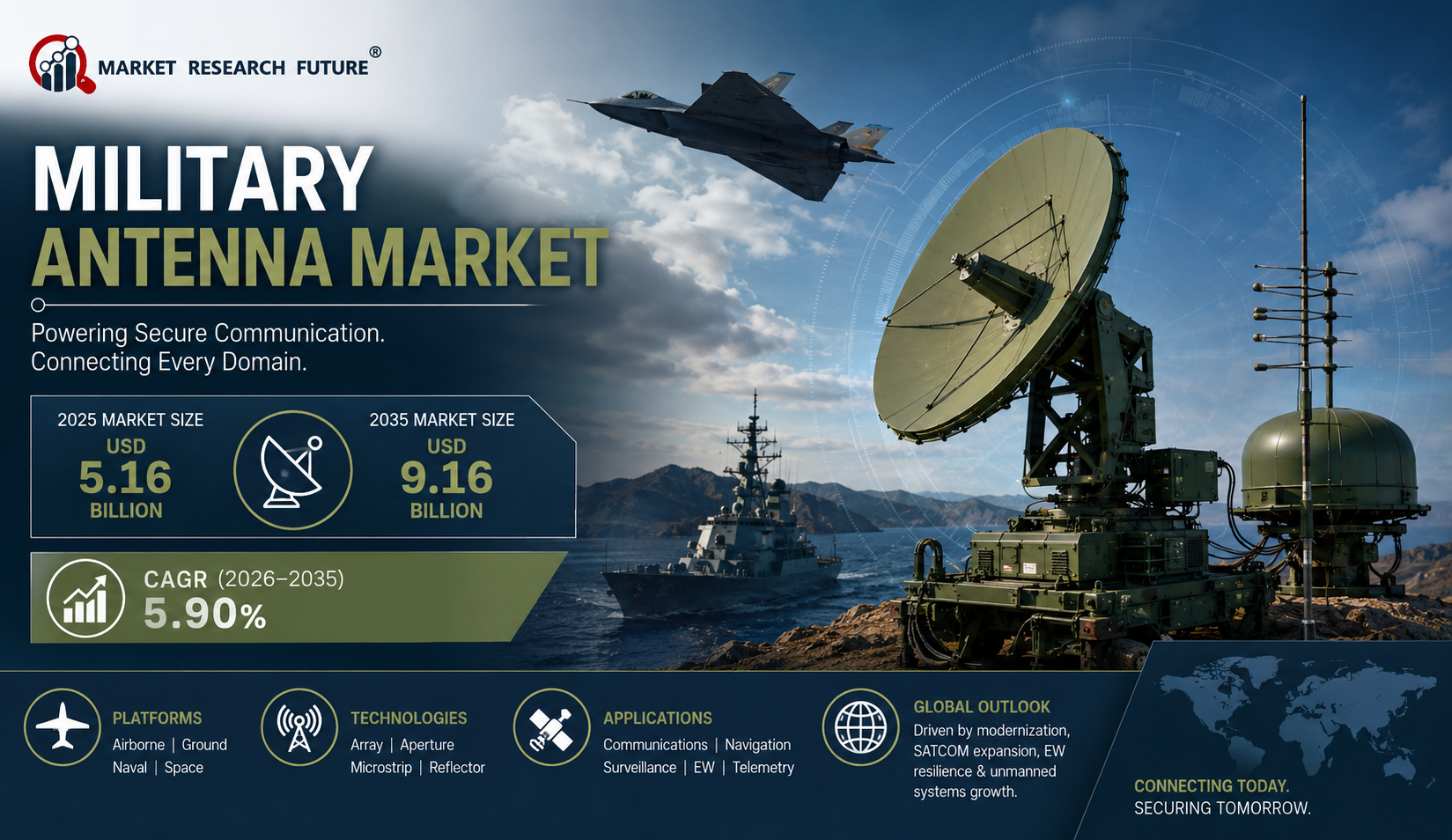
Global military antenna market is projected to grow from USD 5.16 billion in 2025 to USD 9.16 billion by 2035, registering a CAGR of 5.90% during 2026–2035.
NEW YORK, NY, UNITED STATES, July 21, 2026 /EINPresswire.com/ -- The global Military Antenna Market is undergoing a significant transformation, driven by the increasing complexity of modern warfare and the rising demand for secure, resilient, and high-speed communication systems. Military antennas form the backbone of defense communication networks, enabling data transmission across land, air, sea, and space platforms. With advancements in battlefield digitization and the integration of network-centric warfare strategies, antennas are no longer passive components but active enablers of mission-critical operations.This steady growth reflects the increasing investments in defense modernization programs, satellite communication infrastructure, and advanced electronic warfare capabilities. Governments worldwide are prioritizing communication superiority, which has elevated the importance of high-performance antenna systems across multiple applications.
Latest Trends:
The Military Antenna Market is witnessing rapid technological advancements that are reshaping how communication systems are designed and deployed. One of the most prominent trends is the adoption of software-defined and cognitive antenna architectures. These antennas are capable of dynamically adapting to different frequency bands, modulation schemes, and operational conditions. Unlike traditional antennas, which operate within fixed parameters, software-defined antennas provide flexibility and scalability, enabling armed forces to upgrade capabilities without replacing hardware. This is particularly valuable in environments where spectrum congestion and electronic interference are prevalent.
Request Sample of Report: https://www.marketresearchfuture.com/sample_request/6882
Another key trend is the rise of the multi-orbit terminal ecosystem, which integrates communication across Low Earth Orbit (LEO), Medium Earth Orbit (MEO), and Geostationary Orbit (GEO) satellites. Modern military operations require uninterrupted connectivity, even in remote or contested regions. Multi-orbit antennas allow seamless switching between satellite networks, ensuring redundancy and reliability. This capability is especially critical for intelligence, surveillance, and reconnaissance (ISR) missions, as well as for command-and-control operations.
The increasing deployment of phased array and active electronically scanned array (AESA) antennas is also transforming the market. These antennas offer beam steering without mechanical movement, enabling faster response times, higher accuracy, and improved reliability. AESA technology is widely used in advanced radar systems, fighter aircraft, and naval vessels, where precision and speed are crucial. Additionally, these antennas support multiple simultaneous operations, such as tracking and communication, which enhances overall mission efficiency.
Miniaturization and conformal antenna designs are gaining traction, particularly for stealth platforms and unmanned systems. Conformal antennas are integrated into the surface of the platform, reducing aerodynamic drag and radar cross-section. This design approach is essential for modern military assets that require both high performance and low observability. The growing use of drones and autonomous systems further accelerates the demand for compact, lightweight, and energy-efficient antenna solutions.
Another emerging trend is the focus on indigenous manufacturing and localized supply chains. Countries in Asia-Pacific, the Middle East, and Latin America are investing in domestic production capabilities to reduce dependency on foreign suppliers. This shift is driven by geopolitical tensions and the need for strategic autonomy. As a result, local companies are entering the market, creating new opportunities for partnerships and technology transfer.
Drivers and Opportunities:
The Military Antenna Market is driven by a combination of strategic defense initiatives and technological advancements. One of the primary drivers is the modernization of Joint All-Domain Command and Control (JADC2) systems, which contributes approximately 22–26% to the overall market growth. JADC2 aims to integrate data from multiple domains into a unified network, enabling real-time decision-making and coordinated operations. Antennas play a critical role in this ecosystem by ensuring seamless communication across different platforms and environments.
The proliferation of Low Earth Orbit (LEO) satellite constellations is another major growth driver, accounting for 18–22% of the market impact. LEO satellites provide low-latency communication, which is essential for real-time applications such as drone operations and battlefield coordination. However, tracking multiple fast-moving satellites requires advanced antenna systems with high precision and adaptability, driving demand for next-generation solutions.
The rapid expansion of unmanned systems, including UAVs, unmanned ground vehicles (UGVs), and autonomous naval platforms, is contributing 14–17% to market growth. These systems rely heavily on robust communication links for remote operation, data transmission, and navigation. As the use of unmanned systems increases, so does the demand for compact and high-performance antennas that can operate in challenging environments.
The growing emphasis on electronic warfare (EW) and spectrum resilience is another key driver. Modern battlefields are characterized by intense electromagnetic activity, including jamming and interference. Antennas must be capable of operating in contested environments, maintaining signal integrity and reliability. This has led to increased investment in adaptive and anti-jamming technologies.
Opportunities in the market are closely tied to emerging technologies and defense strategies. The adoption of software-defined antennas presents significant potential for scalability and cost efficiency. These antennas can be reprogrammed to support new frequencies and applications, reducing the need for hardware upgrades.
The push for indigenous defense manufacturing programs in emerging markets is creating opportunities for local players and international collaborations. Governments are offering incentives and establishing policies to promote domestic production, which is expected to drive long-term growth.
The development of a multi-orbit terminal ecosystem represents a transformative opportunity, enabling integrated communication networks across different satellite layers. This capability is expected to redefine military communication strategies, providing enhanced connectivity and operational flexibility.
Recent Developments:
September 2023 – India’s Defence Research and Development Organisation (DRDO) successfully tested an indigenously developed active electronically scanned array (AESA) antenna for the Tejas Mk2 fighter aircraft. This achievement marks a significant step toward self-reliance in defense technology and highlights the country’s growing capabilities in advanced antenna systems.
May 2026 – AeroVironment was awarded a USD 43 million contract by the Department of War’s Test Resource Management Center to integrate its PANTHER phased array antenna system into SkyRange platforms. This development underscores the increasing demand for advanced antenna systems in testing and operational environments, particularly for missile tracking and range modernization.
Profiles of Top Companies:
The Military Antenna Market is characterized by intense competition, with leading players focusing on innovation, strategic partnerships, and product diversification.
L3Harris Technologies (8–11%) is a market leader with a comprehensive portfolio that includes multi-band SATCOM terminals, MUOS antennas, and electronic warfare apertures. Its ability to deliver solutions across all platforms makes it a dominant player in the industry.
RTX Corporation (7–10%) leverages its expertise in radar and defense systems to offer AESA arrays, GPS anti-jam antennas, and space-based payloads. Its strong integration with advanced defense programs enhances its competitive position.
BAE Systems (6–9%) specializes in electronic warfare and naval antenna systems, offering conformal arrays and submarine communication solutions. Its focus on high-performance systems makes it a key player in specialized segments.
Cobham Advanced Electronic Solutions (5–8%) is known for its expertise in airborne connectivity, providing SATCOM antennas and electronic support measure arrays. Its specialization in aviation applications gives it a strong niche position.
Thales Group (5–7%) plays a crucial role in the European market, offering shipboard multifunction arrays and ground-based SATCOM systems. Its strong relationships with NATO and European defense agencies enhance its market presence.
Northrop Grumman (4–7%) focuses on space and airborne antenna technologies, delivering advanced solutions for satellite communication and radar systems.
General Dynamics Mission Systems (4–6%) excels in ground-based communication systems, providing tactical radio antennas and integrated C4ISR solutions.
Rohde & Schwarz (3–5%) is a leading provider of tactical communication antennas, particularly in the HF, VHF, and UHF bands.
Lockheed Martin (3–5%) integrates antenna systems into its platforms, including fighter aircraft and space-based systems, leveraging its position as a major defense contractor.
Elbit Systems (3–5%) offers wideband tactical antennas and mobile SATCOM solutions, with a strong presence in export markets.
Regional Analysis:
North America dominates the Military Antenna Market, accounting for 44.0% of the global share in 2025. The region’s leadership is driven by significant investments in defense modernization, particularly in JADC2 systems, SATCOM infrastructure, and electronic warfare capabilities. The United States remains the largest contributor, with extensive R&D activities and a strong defense industrial base.
Europe holds a 25.0% market share, supported by NATO interoperability requirements and collaborative defense programs. Countries such as the United Kingdom, France, and Germany are investing heavily in advanced communication systems to enhance regional security and operational efficiency.
Asia-Pacific is the fastest-growing region, with a CAGR of 7.2% during the forecast period. The region’s growth is driven by increasing defense budgets, indigenous manufacturing initiatives, and rising geopolitical tensions. Countries such as China, India, and Japan are leading the adoption of advanced antenna technologies.
South America, with a market size of USD 0.26 billion in 2025, is focusing on border surveillance and tactical communication upgrades. The region is gradually increasing its defense investments, creating opportunities for market growth.
The Middle East & Africa, valued at USD 0.36 billion in 2025, is characterized by increasing procurement of C4ISR systems and offset-driven partnerships. Countries in this region are investing in advanced communication technologies to strengthen their defense capabilities.
Segment Analysis:
The Military Antenna Market is segmented based on platform, frequency band, technology, application, and component, each playing a vital role in the overall market structure.
By Platform, the market includes airborne, ground, naval, and space segments. Airborne platforms dominate due to the high demand for advanced communication and radar systems in fighter aircraft and UAVs. Naval platforms require robust antennas for long-range communication and maritime surveillance, while space platforms are gaining importance with the expansion of satellite networks.
By Frequency Band, antennas operate across HF, VHF, UHF, SHF, and EHF bands. HF and VHF bands are used for long-range and tactical communication, while UHF, SHF, and EHF bands are essential for satellite communication and high-frequency applications.
By Technology, the market includes wire, aperture, array, reflector, and microstrip antennas. Array and microstrip technologies are gaining popularity due to their compact size and high efficiency, making them suitable for modern military platforms.
By Application, the market is divided into communications, navigation, surveillance, telemetry, and electronic warfare. Communication applications hold the largest share, driven by the need for secure and reliable data transmission.
By Component, the market includes radiating elements, feed networks, radomes, and signal processing units. Signal processing units are becoming increasingly important as antennas evolve into intelligent systems capable of real-time data analysis.
Conclusion:
The Military Antenna Market is poised for steady growth, driven by advancements in communication technologies, increasing defense budgets, and evolving military strategies. With a projected CAGR of 5.90% through 2035, the market offers significant opportunities for innovation and investment.
As defense forces continue to adopt multi-domain operations and network-centric warfare, the demand for advanced antenna systems will continue to rise. Companies that focus on innovation, scalability, and strategic partnerships will be well-positioned to capitalize on the growing opportunities in this dynamic market.
Browse More Reports:
Defense Integrated Antenna Market
https://www.marketresearchfuture.com/reports/defense-integrated-antenna-market-28906
Military Non-steerable Antenna Market
https://www.marketresearchfuture.com/reports/military-non-steerable-antenna-market-32852
Body Worn Antenna Market
https://www.marketresearchfuture.com/reports/body-worn-antenna-market-6408
Sagar Kadam
Market Research Future
+1 628-258-0071
sales@marketresearchfuture.com
Legal Disclaimer:
EIN Presswire provides this news content "as is" without warranty of any kind. We do not accept any responsibility or liability for the accuracy, content, images, videos, licenses, completeness, legality, or reliability of the information contained in this article. If you have any complaints or copyright issues related to this article, kindly contact the author above.
