

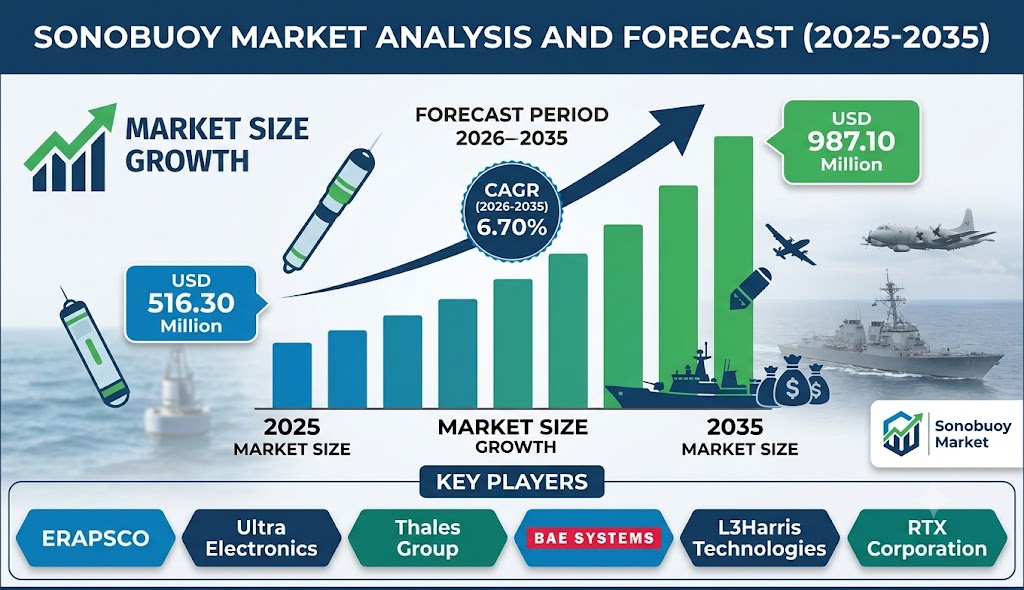
Sonobuoy Market Size to Hit US$ 987.10 Million by 2035, Growing at 6.70% CAGR from 2025 Value US$ 516.30 Million.
Sonobuoy Market
The market is projected to grow from USD 516.30 million in 2025 to USD 987.10 million by 2035, registering a compound annual growth rate (CAGR) of 6.70% during the forecast period 2026–2035. This growth reflects rising geopolitical tensions, increasing submarine activity, and expanding investments in maritime domain awareness. Additionally, advancements in digital signal processing, artificial intelligence, and autonomous deployment platforms are reshaping the technological landscape of the sonobuoy industry.
The growing emphasis on naval modernization programs, particularly among NATO members and Indo-Pacific countries, is accelerating procurement activities. At the same time, commercial applications such as offshore energy exploration and environmental monitoring are opening new revenue streams. These factors collectively position the sonobuoy market as a strategically important segment within the broader defense and maritime technology ecosystem.
Request Sample of Reports: https://www.marketresearchfuture.com/sample_request/6191
Latest Market Trends:
One of the most prominent trends shaping the sonobuoy market is the transition from analog to digital systems. Digital sonobuoys offer enhanced acoustic performance, improved signal clarity, and the ability to process large volumes of data efficiently. This shift is enabling operators to detect quieter and more advanced submarines, which are increasingly designed with stealth capabilities. Digitalization also supports integration with modern command-and-control systems, enhancing situational awareness.
Another significant trend is the integration of sonobuoys with unmanned platforms, including unmanned aerial systems (UAS) and unmanned surface vessels (USVs). These platforms enable safer and more cost-effective deployment, especially in high-risk or contested environments. By leveraging autonomous systems, naval forces can extend surveillance coverage and maintain persistent monitoring without exposing personnel to danger. This trend is particularly relevant in regions with heightened maritime tensions.
The incorporation of edge artificial intelligence (AI) into sonobuoy systems is also gaining traction. Edge AI allows data to be processed directly on the buoy, reducing latency and bandwidth requirements. This capability is crucial in time-sensitive operations where rapid decision-making is essential. Furthermore, AI-driven analytics enhance target detection and classification, improving overall mission effectiveness.
Multi-static sonar networks represent another emerging trend. In such systems, multiple sonobuoys operate collaboratively to detect and track underwater targets. This approach improves detection accuracy and range, especially against modern submarines that employ advanced noise-reduction technologies. The adoption of networked sonar systems is expected to increase as navies seek to enhance their ASW capabilities.
Additionally, the market is witnessing growing interest in commercial applications. Sonobuoys are increasingly used in offshore energy exploration for seismic surveys and underwater mapping. Environmental monitoring and oceanographic research are also benefiting from advancements in acoustic sensing technologies. These applications are diversifying the market and reducing dependence on defense spending.
Key Market Drivers:
The rising number of submarine fleets worldwide is a major driver of the sonobuoy market, contributing approximately +1.6% to CAGR growth. Countries in Asia-Pacific and Europe are expanding their submarine capabilities to strengthen naval deterrence. This trend is driving demand for advanced detection systems, including sonobuoys, to monitor underwater activities effectively.
Multi-year defense procurement programs, particularly in North America, are another critical growth driver, contributing +1.4% to CAGR. Long-term contracts provide stability to manufacturers and ensure a consistent demand pipeline. These programs also encourage innovation and the development of next-generation technologies.
The migration toward digital signal processing technologies contributes approximately +1.1% to CAGR. Digital systems offer superior performance compared to traditional analog solutions, enabling more accurate detection and classification of underwater targets. This technological shift is essential for addressing evolving threats in modern naval warfare.
Integration with unmanned platforms adds around +0.9% to CAGR, reflecting the growing adoption of autonomous systems in maritime operations. These platforms enhance operational efficiency and reduce risks, making them increasingly attractive to defense agencies.
NATO’s collective defense spending commitments contribute +0.7% to CAGR, particularly in Europe. Increased defense budgets are being allocated to enhance ASW capabilities, driving demand for sonobuoy systems.
Offshore energy exploration, especially in South America and the Middle East & Africa, contributes approximately +0.5% to CAGR. The need for advanced acoustic sensing technologies in seismic surveys is boosting demand in the commercial segment.
The AUKUS undersea surveillance initiative contributes +0.4% to CAGR, highlighting the strategic importance of advanced underwater monitoring technologies in the Indo-Pacific region.
Emerging Opportunities:
The development of autonomous undersea surveillance networks presents a significant growth opportunity. These networks integrate multiple sensors, including sonobuoys, to provide comprehensive and real-time situational awareness. Such systems are particularly valuable in monitoring vast ocean areas and detecting potential threats.
Offshore energy exploration in emerging markets is another promising opportunity. As countries invest in offshore oil and gas projects, the demand for reliable acoustic monitoring solutions is expected to increase.
On-buoy edge AI and data monetization represent a transformative opportunity. By processing data locally, sonobuoys can generate valuable insights that can be monetized, creating new revenue streams for manufacturers and service providers.
Recent Developments:
January 2025 – Thales Group signed a multi-year agreement to supply SonoFlash sonobuoy systems to the French Navy. This contract strengthens domestic production capabilities and enhances supply chain resilience, ensuring consistent availability of critical defense technologies.
February 2024 – The Indian Navy entered into a government-to-government agreement with the United States for the procurement of sonobuoy kits to support its P-8I Neptune aircraft fleet. This development underscores the growing importance of maritime surveillance in the Indo-Pacific region and highlights the increasing collaboration between allied nations.
These developments reflect the ongoing efforts by governments and defense organizations to strengthen their underwater surveillance capabilities and enhance operational readiness.
Profiles of Top Companies:
The sonobuoy market is characterized by the presence of established defense contractors and specialized technology providers. These companies are focusing on innovation, strategic partnerships, and long-term contracts to maintain their competitive positions.
1. ERAPSCO (L3Harris / Sparton JV) holds a dominant position in the market, with an estimated revenue share of 18–23%. As the sole supplier of sonobuoys to the U.S. Navy, the company offers a comprehensive range of passive and active systems, including the AN/SSQ series. Its strong relationship with the U.S. defense sector provides a significant competitive advantage.
2. Ultra Electronics (Cobham Ultra) accounts for approximately 14–18% of the market. The company is a leading supplier to NATO and offers advanced digital sonobuoys, including the Barra series. Its focus on innovation and strong presence in European defense programs support its growth.
3. Thales Group, with a market share of 9–13%, provides integrated sonar solutions and advanced processing systems. The company’s strong foothold in European defense markets and its focus on digital technologies position it as a key player.
4. BAE Systems holds a market share of 7–11% and specializes in signal-processing technologies and integration with naval platforms. Its solutions enhance operational efficiency and support advanced ASW missions.
5. L3Harris Technologies captures around 6–9% of the market, offering multi-mission sonar systems and integration capabilities for unmanned platforms. The company’s focus on cross-platform sensing technologies aligns with emerging market trends.
6. RTX Corporation contributes 4–7% of the market, providing advanced acoustic processing systems and acting as a systems integrator for complex defense applications.
7. General Dynamics holds a 3–6% share, leveraging its expertise in submarine systems and C4ISR solutions to support underwater warfare operations.
8. Leonardo S.p.A. accounts for 3–5% of the market, offering sonar processing systems and integration with naval helicopters. Its presence in Southern Europe strengthens its regional position.
9. Elbit Systems holds a 2–4% share and is known for its innovations in unmanned maritime systems, including sonobuoy deployment via USVs.
10. ATLAS Elektronik (thyssenkrupp) also accounts for 2–4% of the market, focusing on sonar systems and integration with naval platforms, particularly in Germany.
Regional Analysis:
North America dominates the global sonobuoy market, accounting for 38.9% of the market share in 2025. The region benefits from strong defense spending, advanced naval capabilities, and long-term procurement programs. The presence of major industry players and extensive use of maritime patrol aircraft further drive demand.
Europe represents a significant market, valued at USD 126.50 million in 2025. Increasing geopolitical tensions and NATO commitments are driving investments in ASW technologies. Countries in the region are focusing on modernizing their naval forces and enhancing underwater surveillance capabilities.
Asia-Pacific is the fastest-growing region, with a projected CAGR of 12.4% during 2026–2035. The expansion of submarine fleets and strategic initiatives such as AUKUS are key growth drivers. Countries like China, India, and Australia are investing heavily in maritime security, creating substantial opportunities for market players.
South America, with a market size of USD 41.30 million in 2025, is driven primarily by offshore energy exploration activities. The region’s focus on developing pre-salt reserves is increasing demand for acoustic sensing technologies.
The Middle East & Africa region is expected to grow at a CAGR of 7.20%, supported by naval modernization programs and increasing investments in maritime security. Countries in the Gulf region are particularly focused on enhancing their defense capabilities.
Segment Analysis:
1. By Type - The market is segmented into active, passive, and special-purpose sonobuoys. Active sonobuoys are widely used in tactical operations due to their ability to emit sound waves and detect reflections. Passive sonobuoys, on the other hand, detect sound emitted by submarines, offering stealth advantages. Special-purpose sonobuoys are designed for specific applications, including environmental monitoring and specialized military missions.
2. By Size Class - The market includes Size A and Size B sonobuoys. Size A is the standard configuration used in most military applications due to its compatibility with aircraft deployment systems. Size B represents smaller variants designed for specialized or compact deployment scenarios.
3. By Deployment Method - Deployment methods include free-fall, cartridge/pneumatic launch, and spring launch systems. Free-fall is the simplest method and is commonly used in aerial operations. Cartridge and pneumatic launch systems provide controlled deployment and are widely used in naval platforms. Spring launch systems offer precision deployment in specific scenarios.
4. By Application - The defense segment dominates the market, driven by increasing ASW requirements and naval modernization programs. However, the commercial segment is gaining traction, particularly in offshore energy exploration and environmental monitoring. This diversification is expected to contribute to long-term market growth.
Conclusion:
The global sonobuoy market is poised for sustained growth over the forecast period, driven by advancements in technology, increasing defense expenditures, and expanding commercial applications. The integration of digital systems, artificial intelligence, and autonomous platforms is transforming the industry, enabling more efficient and effective underwater surveillance.
As geopolitical tensions continue to shape defense strategies, the demand for advanced ASW capabilities will remain strong. At the same time, the growing importance of offshore energy exploration and environmental monitoring is expanding the market’s scope beyond traditional defense applications.
Overall, the sonobuoy market represents a dynamic and evolving sector with significant opportunities for innovation and growth. Companies that invest in advanced technologies and strategic partnerships are well-positioned to capitalize on emerging trends and maintain a competitive edge in this critical industry.
Browse More Reports:
Sonobuoy Launcher Market
https://www.marketresearchfuture.com/reports/sonobuoy-launcher-market-7203
Anti Submarine Warfare Market
https://www.marketresearchfuture.com/reports/anti-submarine-warfare-market-23768
Undersea Warfare Systems Market
https://www.marketresearchfuture.com/reports/undersea-warfare-systems-market-23092
Sagar Kadam
Market Research Future
+ + +1 628-258-0071
sales@marketresearchfuture.com
Legal Disclaimer:
EIN Presswire provides this news content "as is" without warranty of any kind. We do not accept any responsibility or liability for the accuracy, content, images, videos, licenses, completeness, legality, or reliability of the information contained in this article. If you have any complaints or copyright issues related to this article, kindly contact the author above.
