

Remedia™ Hydrocarbon Stabilizer Helps Control Coal-Tar During Deep Brownfield Cleanup in Brooklyn's Gowanus Neighborhood
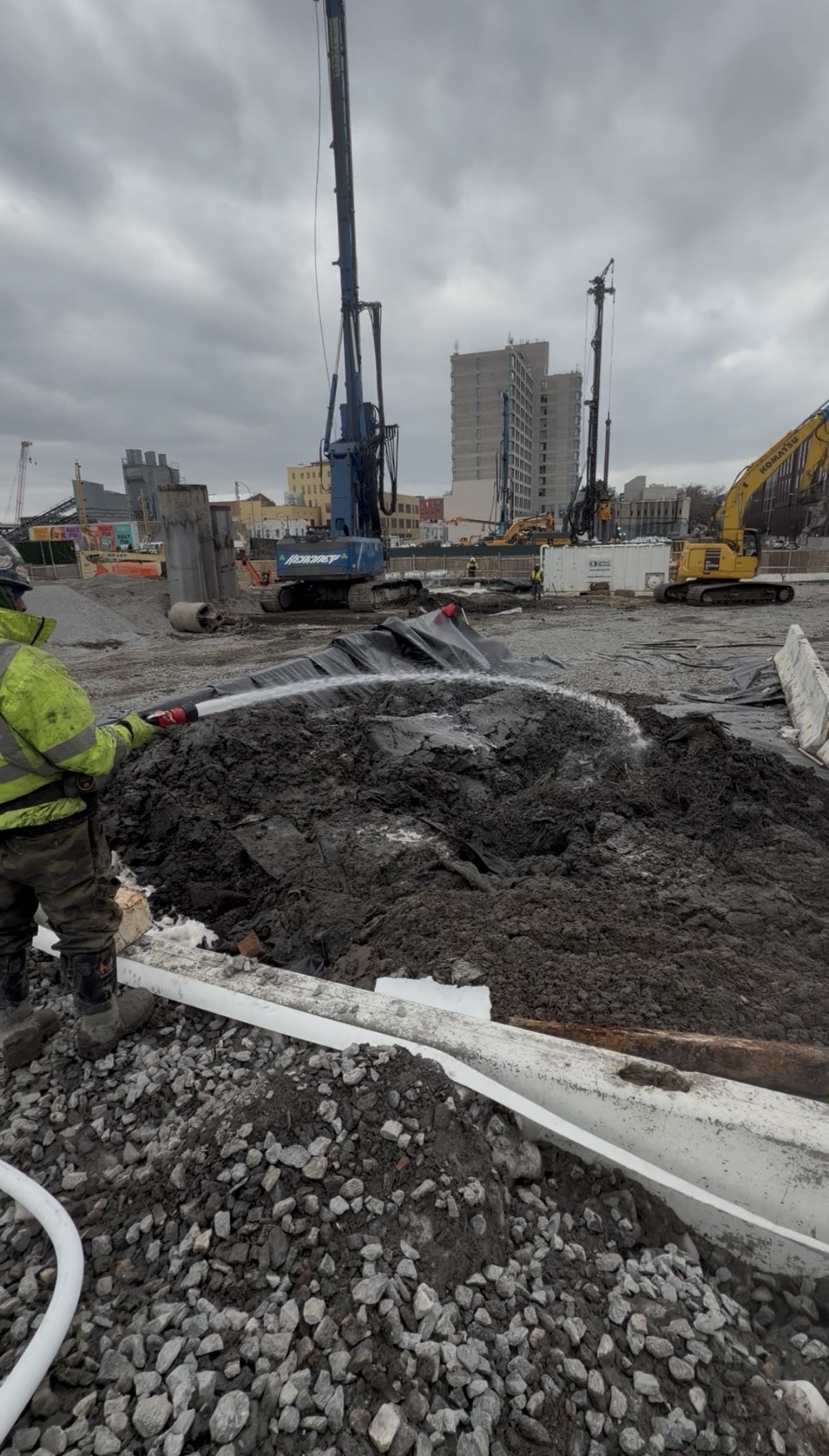
Operators apply Remedia solution to excavated stockpile
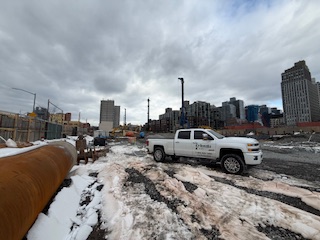
Remedia personnel arrive on site
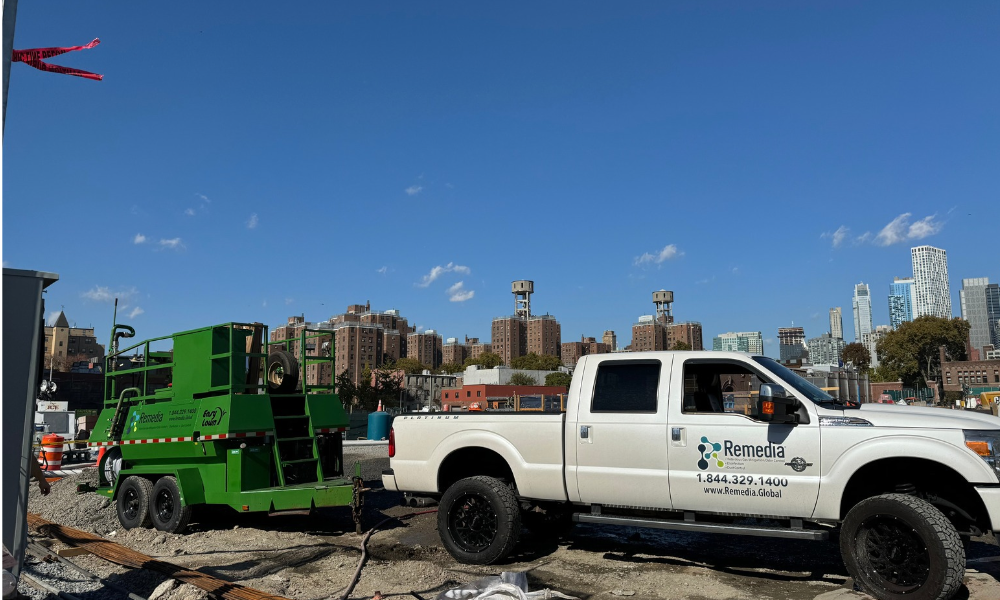
Remedia on site delivering hydro-application equipment on site
Remedia™ Hydrocarbon Stabilizer was used at 318 Nevins Street to control odors while buried coal tar was removed next to occupied homes and businesses
BROOKLYN, NY, UNITED STATES, September 29, 2026 /EINPresswire.com/ -- Remedia today released a case study on its role in the cleanup of 318 Nevins Street in Brooklyn's Gowanus neighborhood. The site is enrolled in the New York State Department of Environmental Conservation (NYSDEC) Brownfield Cleanup Program as Site C224350. Remedia™ Hydrocarbon Stabilizer was specified to control odors while crews drilled out and removed coal-tar contamination buried up to 35 feet underground.The Problem: A Century of Contamination Under One City Block
The roughly 2.3-acre property sits just east of the Gowanus Canal, a federal Superfund waterway, in one of Brooklyn's fastest-redeveloping areas. Over the years the site was used as a lumber yard, coal and coke yards, a motor freight terminal, a telephone facility and a food commissary. Over many decades, coal tar also moved underground onto the property from the former Fulton Municipal Works Manufactured Gas Plant, about 325 feet to the north. Coal tar is a thick, oily byproduct of turning coal into gas, and engineers call it NAPL (non-aqueous phase liquid).
During the investigation, coal tar turned up in 42 of 63 deep test borings, mostly 20 to 35 feet below the surface and below the water table. NYSDEC's October 2023 Decision Document named these contaminants of concern:
Coal tar, both as liquid NAPL and as heavily contaminated soil.
Coal-tar compounds (PAHs): benzo(a)anthracene, benzo(a)pyrene, benzo(b)fluoranthene, benzo(k)fluoranthene and chrysene. Soil levels reached as high as 200 parts per million (ppm), against a residential cleanup standard of 1 ppm for most of them.
Naphthalene, the mothball-smelling compound in coal tar. It reached 5,800 ppm in soil and 8,000 parts per billion (ppb) in groundwater. The groundwater standard is 10 ppb.
Arsenic and lead. Soil levels reached 160 ppm and 2,900 ppm, compared with cleanup standards of 16 ppm and 400 ppm.
Chlorinated solvents TCE and PCE in soil vapor. NYSDEC determined these vapors do not originate from on-site contamination.
Groundwater also contained the "forever chemicals" PFOA and PFOS, at up to 362 and 178 parts per trillion. Both are above the 10-part-per-trillion drinking water limit.
Coal tar has a strong, lingering smell. Any digging or drilling into it could release odors into the surrounding residential neighborhood, which is not allowed under the site's state cleanup requirements. On a project like this, odor control can decide whether the work moves forward or stops.
The Cleanup Approach
In October 2023, NYSDEC selected a cleanup plan that included excavation, a protective cover system, vapor controls, and in-situ solidification (ISS). ISS mixes cement-based materials into contaminated soil underground so it hardens in place and locks the contamination up. From January to April 2025, crews solidified about half an acre of coal-tar-affected ground this way.
Some treatment columns hit buried concrete foundations and rebar 8.5 to 11 feet down. Those obstructions stopped them from reaching the planned depth and left some coal tar untreated below. The state-approved fix was to drill out about 85 locations with a 48-inch steel casing and 42-inch auger and physically lift the tar-soaked soil out. Bringing that material to the surface is the point where odors are most likely to escape. It is also where Remedia was specified.
How Hydrocarbon Stabilizer Delivered
Stopping odors before they start. Most odor controls react after contaminated soil is already exposed. Remedia™ Hydrocarbon Stabilizer works earlier. Crews applied it directly into the drill casing, above and within the coal-tar zones, during active drilling. That stabilized the hydrocarbons and suppressed odors before the spoils ever reached the surface.
Protection that follows the equipment. Augers, core barrels and other drilling equipment that touched the coal tar were sprayed with Hydrocarbon Stabilizer whenever they were staged or out of service. This suppressed odors, reduced volatilization and cut the risk of cross-contamination around the site. Equipment was fully decontaminated at the end of each workday.
Proven under a strict standard. The work ran under a downwind community air monitoring station and handheld detectors. Work had to stop if limits at the site boundary were exceeded. Hydrocarbon Stabilizer was built into the odor-control plan for exactly this kind of scrutiny.
Easy to deploy in the field. Because it is a water-based liquid, Hydrocarbon Stabilizer went straight into the casing and onto equipment without specialized handling. Dedicated laborers applied it throughout the drilling program.
Remedia™ Hydrocarbon Stabilizer treats contamination where it sits, rather than covering it up or moving it somewhere else. The water-based aqueous catalyst uses Remedia's patented RTL Technology to mitigate petroleum and other organic contaminants through catalytic conversion. Crews can spray onto impacted soil, water, hard surfaces and equipment, or apply it directly at the source via injecting or during drilling activities. Once applied, it acts quickly to reduce harmful emissions, suppress the odors and reduce concentrations of contaminants. Because it is more than 87% water and inert ingredients, non-flammable, and not classified as a carcinogen, it lets contractors control contamination at the point of disturbance without adding new hazards for crews, neighbors or the surrounding environment.
Safe for Crews and Neighbors
Hydrocarbon Stabilizer is well suited to work right next to where people live and work. According to the Safety Data Sheet filed with NYSDEC, Remedia™ Hydrocarbon Stabilizer is a water-based, essentially odorless, non-flammable liquid made of more than 87% water and inert ingredients. It is not classified as a carcinogen by IARC, OSHA, or NTP. It has no CERCLA reportable quantity, is fully TSCA-listed, is not on California's Proposition 65 list, and carries an HMIS rating of Health 1 / Fire 0 / Physical 0.
"For Gowanus-area sites sitting over migrated gas-plant coal tar, the deciding factor is rarely whether the contamination can be removed. It's whether it can be removed without an odor event next door," said Wyatt Schwab, VP of Operations at Remedia. "Hydrocarbon Stabilizer goes to work at the source, inside the casing, before odors have a chance to escape. That's what makes it possible to take on jobs like 318 Nevins in the middle of a neighborhood."
Results
The hardest part of the job got done. With Hydrocarbon Stabilizer controlling odors at the source, crews drilled out and removed coal tar from about 85 locations in the middle of an occupied neighborhood. The work stayed under NYSDEC's odor-nuisance requirements and continuous perimeter air monitoring.
Contamination addressed to full depth. Combining solidification with stabilizer-supported source removal took the coal tar down to the design depth of −19 feet (NAVD88), including beneath the obstructions that had blocked earlier treatment.
Regulators on board. Hydrocarbon Stabilizer was written into the NYSDEC-approved Source Removal Work Plan, with its Safety Data Sheet filed alongside it. Each phase followed the state-approved work plan and DER-10 guidance, which kept the Brownfield Cleanup Program schedule on track.
A cleaner future for the block. The overall cleanup, which also addresses the site's metals, PAHs, soil vapor and groundwater, positions the property for new restricted-residential use under the Gowanus rezoning.
A Model for Gowanus and Beyond
Many properties along the Gowanus Canal sit over coal tar that migrated from former gas plants. These sites face the same challenge: removing deep contamination without disturbing the neighbors. 318 Nevins Street shows how stabilizing odors at the source can make that work possible. Hydrocarbon Stabilizer offers a simple, water-based option for developers, engineers and contractors working on dense urban brownfields.
Project Timeline
2012–2021: Environmental assessments identify historic fill, petroleum, PAHs, and soil-vapor contamination
2022: Site accepted into the NYSDEC Brownfield Cleanup Program
2022–2023: 83 deep borings and monitoring wells map the coal tar
October 12, 2023: NYSDEC issues its Decision Document selecting the remedy
December 2024: Solidification mix finalized after lab and field testing
January 6 – April 11, 2025: Full-scale in-situ solidification completed
May 2025: Drilling supported by Remedia Hydrocarbon Stabilizer removes remaining coal tar under obstructed areas
The engineer of record was Impact Environmental Engineering & Geology, PLLC. All technical details come from documents filed with NYSDEC, which are publicly available in the NYSDEC DECDocs repository for Site C224350.
About Remedia
Remedia develops water-based treatment products for hydrocarbon, petroleum, and VOC odor control and stabilization. Its products are used in environmental remediation, brownfield redevelopment, landfill, oil and gas, and industrial settings. For more information, visit www.Remedia.Global.
Wyatt Schwab
Remedia International, Inc.
+1 844-329-1400
email us here
Visit us on social media:
Instagram
Facebook
Legal Disclaimer:
EIN Presswire provides this news content "as is" without warranty of any kind. We do not accept any responsibility or liability for the accuracy, content, images, videos, licenses, completeness, legality, or reliability of the information contained in this article. If you have any complaints or copyright issues related to this article, kindly contact the author above.
