

Recent advances in fiber-tip integration based on femtosecond laser 3D printing

Schematic illustration of fiber-tip integration based on femtosecond laser 3D printing: principles, materials and applications.
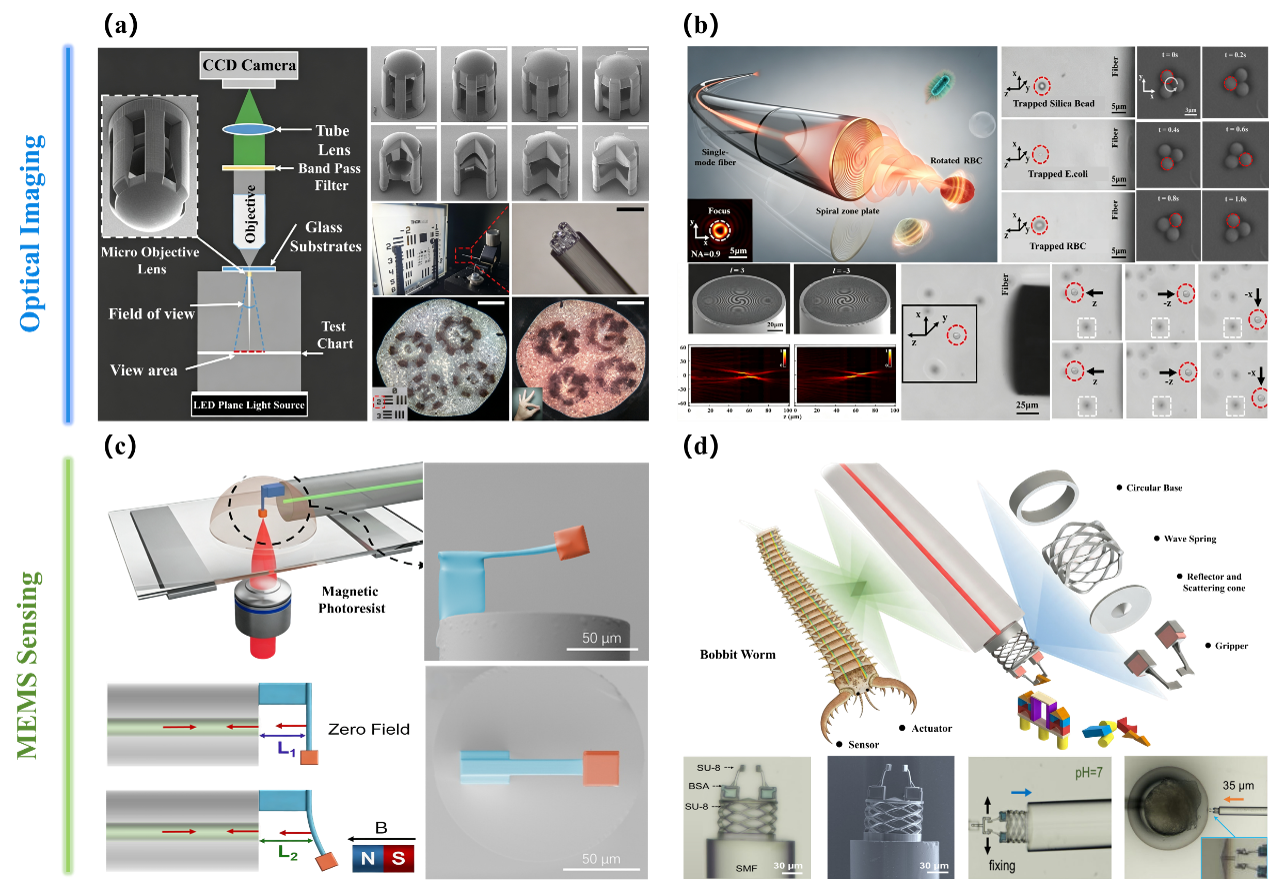
Representative applications of femtosecond laser 3D-printed fiber-tip devices

Emerging trends in fiber-tip integration enabled by femtosecond laser 3D printing.
SHANNON, CLARE, IRELAND, October 13, 2026 /EINPresswire.com/ -- Announcing a new publication from Opto-Electronic Manufacturing; DOI 10.29026/oem.2026.260003.
Femtosecond laser 3D printing is emerging as a versatile way to build miniature optical and sensing functions directly onto fiber tips. This review summarizes advances in printable materials, high-precision and high-throughput fabrication, optical imaging, and MEMS sensing. It also identifies major challenges in material performance, manufacturing efficiency, and device integration, and outlines future opportunities for robust, multifunctional fiber-tip devices in biomedical diagnostics, environmental monitoring, precision manufacturing, and other demanding real-world applications.
An optical fiber can be thought of as a highway for light. It carries information over long distances, reaches confined spaces, and works reliably even in environments where electromagnetic interference would disrupt conventional electronics. These advantages have made optical fibers essential in communications, medical imaging, and sensing. Yet most fibers are designed mainly to transmit light. As healthcare, intelligent manufacturing, and precision sensing move toward smaller and more integrated systems, researchers increasingly want the fiber itself to do more at its tip—such as focus light, form images, or detect changes in the surrounding environment.
This has led to growing interest in fiber-tip integration: building tiny functional structures directly on the end of an optical fiber. The idea is simple, but the manufacturing challenge is substantial. The usable area at a fiber tip is extremely small, and conventional fabrication methods often require multiple processing steps, masks, vacuum systems, or mostly planar patterning. Creating complex three-dimensional structures in such a restricted space can therefore be difficult.
Femtosecond laser 3D printing offers a different approach. It can be pictured as using an extremely fine “light pen” to write structures in three dimensions. Ultrashort laser pulses are tightly focused into a tiny volume, so only material near the focal point is modified. By moving that focal point through space, researchers can directly fabricate microlenses, microcantilevers, microcavities, and other miniature structures on a fiber tip. The method is particularly attractive because it combines true 3D design freedom with high spatial precision and does not rely on conventional masks.
Over the past decade, this approach has expanded from proof-of-concept microstructures to functional devices for miniature imaging, beam shaping, and sensing of force, gases, temperature, and magnetic fields. At the same time, the field still faces important barriers, including limited material choices, the trade-off between printing speed and precision, and long-term integration reliability. A systematic review is therefore valuable for showing what the technology can already achieve, where its limitations lie, and what advances are needed for practical fiber-tip devices.
The research teams led by Professors Yiping Wang and Changrui Liao at Shenzhen University reviewed recent progress in femtosecond-laser-enabled fiber-tip integration in an invited article, “Recent Advances in Fiber-Tip Integration Based on Femtosecond Laser 3D Printing,” published in Issue 1 of Opto-Electronic Manufacturing in 2026. Rather than simply listing individual techniques, the review organizes the field around practical questions: what materials can be printed, how structures can be fabricated with both high precision and high efficiency, what functions can be integrated onto a fiber tip, and what challenges must be overcome next.
The review classifies printable materials into organic, organic–inorganic hybrid, and inorganic systems. These materials can be viewed as the “building materials” of fiber-tip devices: some are easy to process and suitable for transparent micro-optics; others offer greater mechanical or thermal stability; still others can respond to gases, temperature, or magnetic fields. The authors emphasize that future devices will need not only smaller structures, but also materials with richer and more robust functions.
Another central issue is the trade-off between precision and speed. Point-by-point laser writing can produce very fine features but is relatively slow, while projection-based methods can fabricate larger regions much faster but generally provide less control over the smallest details. The review discusses multifocus parallel writing, planar projection, volumetric projection, and hybrid strategies that combine rapid fabrication of large structures with high-precision writing in critical regions.
These developments could have broad impact. In imaging, fiber-tip microlenses and other micro-optical elements can support miniature endoscopy, optical coherence tomography, and beam shaping, helping probes reach narrow or difficult-to-access locations. In sensing, microcantilevers, microcavities, and compliant structures can detect force, gas concentration, temperature, and magnetic fields. Such devices could contribute to minimally invasive medical tools, environmental monitoring, industrial sensing, and measurements in harsh environments.
Looking ahead, the review highlights three priorities: developing materials that tolerate high temperature and pressure while responding to multiple stimuli; creating manufacturing methods that better balance resolution and throughput; and expanding applications in biomedicine and extreme-environment sensing. Together, these directions could transform optical fibers from passive light-delivery channels into compact platforms that can image, sense, and interact with their surroundings directly at the tip.
Keywords: femtosecond laser 3D printing, fiber-tip integration, two-photon polymerization, optical imaging, MEMS sensing
# # # # # #
The work was conducted by researchers from Shenzhen University’s College of Physics and Optoelectronic Engineering, with contributions from the teams of Professors Yiping Wang and Changrui Liao. The group works at the intersection of ultrafast laser micro/nano manufacturing, optical-fiber sensing, micro-optics, and integrated photonic devices, with applications spanning biomedical technologies, intelligent sensing, photonic chips, and advanced manufacturing.
Professor Changrui Liao is a Distinguished Professor and doctoral supervisor at Shenzhen University, Director of the Shenzhen Key Laboratory of Ultrafast Laser Micro/Nano Manufacturing, a recipient of the National Science Fund for Excellent Young Scholars, and Chief Scientist of a National Key R&D Program of China. His research focuses on ultrafast laser micro/nano manufacturing and its applications in sensing, photonics, and healthcare.
Professor Yiping Wang is a Chair Professor and doctoral supervisor at Shenzhen University, a recipient of the National Science Fund for Distinguished Young Scholars, and Director of the Guangdong–Hong Kong Joint Research Centre for Optical Fibre Sensors. His research has long focused on optical-fiber sensing technologies and their applications.
# # # # # #
Opto-Electronic Manufacturing (OEM) is a peer-reviewed, open-access journal within the Opto-Electronic Journals Group. It bridges fundamental research and engineering practice to promote advanced manufacturing, turning technological innovation into tangible industrial impact.
# # # # # #
More information: https://www.oejournal.org/oemanuf/
Editorial Board: https://www.oejournal.org/oemanuf/en/editorial_board/oemEditorialBoard
All issues available in the online archive: https://www.oejournal.org/oemanuf/archive
Submission of OEM may be made using ScholarOne https://mc03.manuscriptcentral.com/oem2026
ISSN 3136-8301
Contact Us: oemanuf@ioe.ac.cn
Twitter: @OptoElectronAdv (https://twitter.com/OptoElectronAdv?lang=en)
WeChat: OE_Journal
# # # # # #
Xuan YY, Zhu DZ, Liu DJ et al. Recent advances in fiber-tip integration based on femtosecond laser 3D printing. Opto-Electron Manuf 1, 260003 (2026). DOI: 10.29026/oem.2026.260003
Opto-Electronic Manufacturing Editorial Office
Opto-Electronic Manufacturing
+ +86 591 2286 1222
oemanuf@ioe.ac.cn
Legal Disclaimer:
EIN Presswire provides this news content "as is" without warranty of any kind. We do not accept any responsibility or liability for the accuracy, content, images, videos, licenses, completeness, legality, or reliability of the information contained in this article. If you have any complaints or copyright issues related to this article, kindly contact the author above.
